
Cloud AI
Artificial intelligence has moved from being a specialized technology used mainly by large technology companies to becoming an important part of everyday digital services. Businesses use AI for customer support, data analysis, automation, marketing, cybersecurity, software development, and many other activities. At the same time, cloud computing has made advanced technology available without requiring every organization to build and maintain expensive physical infrastructure.
The combination of these two technologies has created a powerful approach to modern computing. Cloud AI allows organizations and developers to access artificial intelligence capabilities through cloud-based platforms, services, and infrastructure.
Instead of purchasing and maintaining specialized hardware, companies can use computing resources provided by cloud platforms. This can make AI projects more accessible, flexible, and scalable.
From small businesses experimenting with automation to large organizations processing enormous amounts of data, cloud-based AI can support a wide variety of use cases. However, understanding its benefits, limitations, security considerations, and practical applications is important before adopting it.
This guide explains what cloud-based artificial intelligence means, how it works, its major benefits, common applications, challenges, and the role it may play in the future of technology.
What Is Cloud AI?
Cloud AI refers to artificial intelligence capabilities that are delivered or supported through cloud computing infrastructure.
Traditional AI systems may require organizations to purchase powerful servers, graphics processing units, storage systems, and other hardware. Maintaining this infrastructure can be expensive and technically demanding.
Cloud-based AI changes this model by allowing users to access computing resources over the internet. Depending on the service, users may be able to access machine learning tools, AI models, data-processing systems, computer vision capabilities, natural language processing, and other technologies.
This means organizations can develop or use AI applications without necessarily owning all the hardware required to operate them.
The cloud can provide the computational power, storage, development tools, and infrastructure needed for AI workloads, while users focus more on their applications and business objectives.

How Does Cloud AI Work?
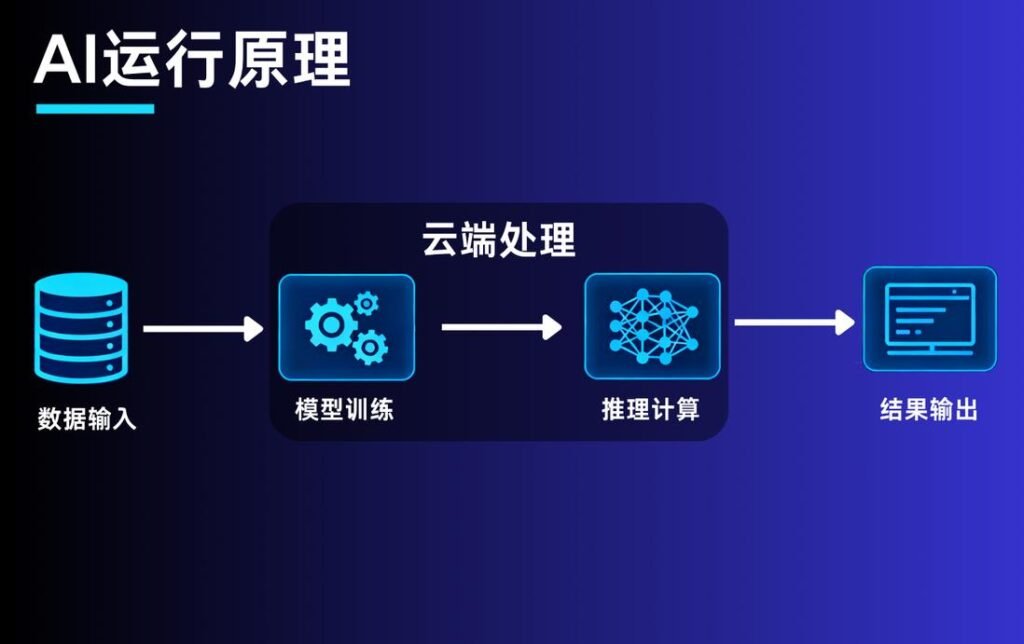
To understand how cloud-based AI works, it helps to look at the relationship between data, computing resources, AI models, and applications.
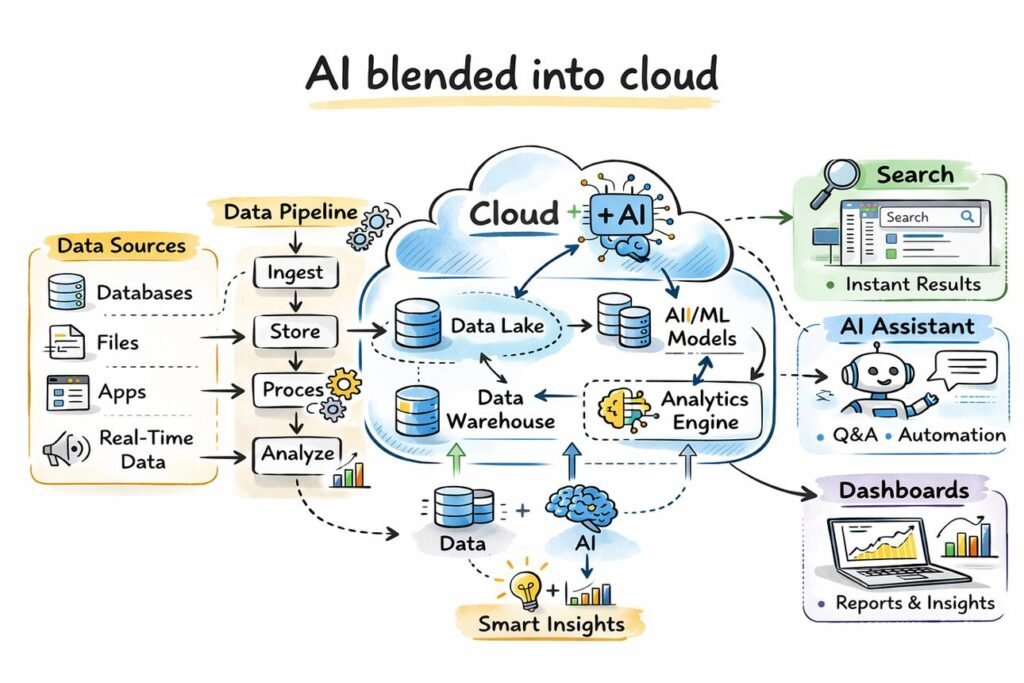
First, data is collected from sources such as websites, applications, databases, sensors, documents, or customer interactions. The data can then be stored using cloud storage systems.
Machine learning models can process this information to identify patterns and generate predictions or classifications.
For example, a company could use an AI system to analyze customer messages and identify common questions. Another organization could process images to detect specific objects or patterns.
The cloud provides the computing resources needed to perform these operations. Organizations can access these resources through software platforms, APIs, managed services, or other cloud-based tools.
This approach can simplify AI development because organizations do not always need to manage the entire physical infrastructure themselves.
Key Components of Cloud-Based AI
Several technologies work together to support cloud AI applications.
Cloud Computing
Cloud computing provides access to computing power, storage, networking, and other infrastructure through remote data centers.
Machine Learning
Machine learning allows systems to identify patterns in data and make predictions or decisions based on those patterns.
Data Storage
AI systems often require significant amounts of data. Cloud storage can provide scalable options for storing structured and unstructured information.
AI Models
Models are trained to perform particular tasks, such as understanding language, recognizing images, making predictions, or generating content.
APIs and AI Services
Cloud providers can offer ready-to-use AI services through APIs. Developers can integrate these capabilities into websites, mobile applications, and business software without building every AI component from scratch.
Why Businesses Are Using Cloud AI
Businesses are constantly looking for ways to improve efficiency while controlling costs. AI can automate repetitive processes, identify useful patterns in data, and assist employees with everyday tasks.
Cloud infrastructure makes these capabilities easier to access.
For a smaller company, building an AI infrastructure from the ground up may be unrealistic. Cloud services can reduce the initial investment because the organization can use existing infrastructure rather than purchasing a complete collection of specialized equipment.
Large companies can also benefit because cloud environments can provide the scale required for demanding workloads.
This flexibility makes cloud-based AI relevant to organizations of different sizes and industries.
Major Benefits of Cloud AI
Scalability
One of the biggest advantages is scalability.
AI workloads can change significantly depending on demand. A company may require more computing power during a major project and less during quieter periods.
Cloud infrastructure can make it easier to adjust resources according to requirements.
Cost Efficiency
Organizations do not necessarily need to purchase large amounts of expensive hardware before starting an AI project.
Cloud services can allow businesses to use computing resources according to their needs. Depending on the pricing model and workload, this can reduce certain infrastructure costs.
However, cloud services are not automatically cheaper in every situation. Organizations still need to monitor usage and manage resources carefully.
Faster Development
Cloud-based tools can provide prebuilt services, development environments, APIs, and machine learning frameworks.
This can reduce the amount of infrastructure work required before developers can begin building an application.
Accessibility
AI technology can become accessible to a wider range of developers and organizations because specialized hardware is not always required on-site.
Flexibility
Teams can experiment with different models, services, and computing resources without completely redesigning their physical infrastructure.

Why Businesses Are Using Cloud AI
Businesses are constantly looking for ways to improve efficiency while controlling costs. AI can automate repetitive processes, identify useful patterns in data, and assist employees with everyday tasks.
Cloud infrastructure makes these capabilities easier to access.
For a smaller company, building an AI infrastructure from the ground up may be unrealistic. Cloud services can reduce the initial investment because the organization can use existing infrastructure rather than purchasing a complete collection of specialized equipment.
Large companies can also benefit because cloud environments can provide the scale required for demanding workloads.
This flexibility makes cloud-based AI relevant to organizations of different sizes and industries.
Major Benefits of Cloud AI
Scalability
One of the biggest advantages is scalability.
AI workloads can change significantly depending on demand. A company may require more computing power during a major project and less during quieter periods.
Cloud infrastructure can make it easier to adjust resources according to requirements.
Cost Efficiency
Organizations do not necessarily need to purchase large amounts of expensive hardware before starting an AI project.
Cloud services can allow businesses to use computing resources according to their needs. Depending on the pricing model and workload, this can reduce certain infrastructure costs.
However, cloud services are not automatically cheaper in every situation. Organizations still need to monitor usage and manage resources carefully.
Faster Development
Cloud-based tools can provide prebuilt services, development environments, APIs, and machine learning frameworks.
This can reduce the amount of infrastructure work required before developers can begin building an application.
Accessibility
AI technology can become accessible to a wider range of developers and organizations because specialized hardware is not always required on-site.
Flexibility
Teams can experiment with different models, services, and computing resources without completely redesigning their physical infrastructure.
Cloud AI in Business Automation
Automation is one of the most practical applications of artificial intelligence.
Businesses often perform repetitive tasks such as sorting documents, responding to common questions, processing information, and categorizing data.
AI can help automate some of these processes.
For example, an organization could use AI to classify incoming customer requests and direct them to the appropriate department. A document-processing system could extract relevant information from invoices or forms.
Automation does not necessarily mean removing humans from the process. In many cases, the better approach is to let AI handle repetitive tasks while employees focus on situations requiring judgment, creativity, and communication.
Cloud AI for Customer Service
Customer support generates large amounts of information through emails, chats, phone interactions, and support tickets.
AI can help organizations organize and analyze this information.
Chatbots can answer common questions, while AI systems can categorize support requests and identify recurring issues.
For example, if many customers are reporting the same problem, an organization can analyze support data to identify the pattern and investigate the underlying cause.
AI-assisted customer service can therefore help businesses respond faster while allowing human support agents to focus on more complicated problems.
Cloud AI in Healthcare
Healthcare is another area where artificial intelligence has significant potential.
AI systems can help analyze medical images, organize information, support research, and identify patterns in large datasets.
Cloud infrastructure can provide the computing resources required for processing large volumes of information.
However, healthcare applications require particularly strong privacy, security, accuracy, and regulatory controls. AI-generated results should not automatically replace qualified medical professionals.
In high-stakes environments, human expertise and appropriate validation remain essential.
Cloud AI in E-Commerce
Online stores generate large amounts of customer and product data.
AI can help analyze shopping behavior, product information, searches, and customer interactions.
One common application is recommendation systems. An AI system can analyze patterns in customer behavior and suggest products that may be relevant.
AI can also support inventory analysis, customer service, fraud detection, and marketing.
For online businesses, these capabilities can help create more personalized experiences while improving operational efficiency.
Cloud AI for Marketing
Marketing teams increasingly rely on data to understand audiences and measure campaign performance.
AI can analyze large datasets and identify patterns that may be difficult to recognize manually.
Businesses can use AI to support tasks such as customer segmentation, content analysis, campaign optimization, and predictive analytics.
Generative AI can also assist with brainstorming, copywriting, image creation, and other creative tasks.
However, human creativity remains important. Marketing content should reflect brand identity, audience needs, cultural context, and business goals rather than simply publishing automatically generated material.
Cloud AI and Software Development
Software developers can use cloud-based AI tools to assist with programming and development workflows.
AI systems can help generate code examples, explain programming concepts, identify potential errors, create documentation, and suggest solutions.
Cloud infrastructure can also provide development environments and computing resources for machine learning projects.
For developers, this can reduce time spent on repetitive activities and allow more attention to system architecture, testing, security, and product design.
Generated code should still be reviewed carefully. Developers remain responsible for checking correctness, performance, security, and compatibility.
Cloud AI and Data Analytics
Modern organizations collect data from websites, applications, sales systems, devices, and other sources.
The challenge is not simply collecting information. Businesses also need to understand what the data means.
AI can help identify patterns, trends, relationships, and potential anomalies.
For example, a retailer might analyze sales information to identify changes in customer demand. A manufacturing company could analyze equipment data to identify unusual behavior.
These insights can support better decision-making when the underlying data is accurate and the AI model is appropriately designed.
Security and Privacy Considerations
Security is one of the most important issues when adopting cloud-based AI.
Organizations may process sensitive business information, customer data, financial records, or proprietary documents.
Before adopting an AI service, businesses should understand how information is stored, processed, protected, and accessed.
Important considerations include:
- Data encryption
- Access controls
- Identity management
- Secure APIs
- Monitoring and logging
- Data retention policies
- Compliance requirements
- Employee access permissions
Privacy should also be considered when AI systems process personal information.
A strong security strategy should be designed before sensitive data is moved into an AI workflow.
Challenges of Cloud AI
Although the technology offers many benefits, it also introduces challenges.
Cost Management
Cloud resources can become expensive if usage grows unexpectedly or resources are poorly managed.
Organizations should monitor workloads and establish appropriate controls.
Data Privacy
Sensitive information must be handled carefully. Organizations need to understand the policies and security practices associated with the services they use.
Internet Dependence
Many cloud-based services require reliable internet connectivity. Network problems can affect access to applications and services.
Vendor Dependence
Relying heavily on one provider can make it difficult to move systems to another environment later.
AI Accuracy
AI models can make mistakes. Businesses should establish appropriate testing and human review processes.
Cloud AI vs Traditional AI Infrastructure
Traditional AI infrastructure generally requires organizations to purchase, install, maintain, and upgrade their own hardware.
Cloud-based approaches move much of this infrastructure management to external cloud providers.
This can make experimentation easier and reduce some hardware-management responsibilities.
However, traditional infrastructure can still make sense for organizations with specific requirements, existing hardware investments, strict control needs, or workloads that are more economical to operate locally.
The best choice depends on factors such as budget, security requirements, workload size, technical expertise, and long-term strategy.
How to Choose the Right AI Cloud Solution
Organizations should evaluate several factors before selecting a cloud AI platform.
Identify the Business Goal
Start with the problem rather than the technology.
Ask what the organization wants to improve. Is the goal automation, customer service, analytics, forecasting, content creation, or another objective?
Evaluate Data Requirements
Determine what data the AI system will use and whether it contains sensitive information.
Consider Scalability
Choose an infrastructure approach that can support future growth.
Review Security
Security requirements should be evaluated before implementation.
Calculate Total Cost
Consider computing, storage, API usage, development, monitoring, and maintenance costs rather than looking only at the initial price.
The Future of Cloud AI
The relationship between cloud computing and artificial intelligence is likely to become increasingly important.
As AI models become more capable, organizations will continue looking for practical ways to integrate them into everyday software and business processes.
Future systems may provide more personalized automation, improved analytics, advanced conversational interfaces, and better integration with existing business applications.
Edge computing may also complement cloud infrastructure by allowing some AI processing to happen closer to where data is generated.
The future is unlikely to involve one single approach. Instead, organizations may combine cloud, local, and edge computing depending on their specific requirements.
Tips for Adopting AI Successfully
Organizations should avoid adopting AI simply because it is popular.
A better approach is to start with a clear business problem.
Begin with a manageable project, establish measurable goals, and evaluate the results.
Employees should also receive appropriate training so they understand how to use AI tools effectively and responsibly.
Human oversight should remain part of important workflows, especially when AI is making recommendations that could affect customers, finances, safety, or other sensitive areas.
Successful AI adoption is not just about technology. It also involves people, processes, data, security, and organizational culture.
Final Thoughts
Cloud AI combines the flexibility of cloud computing with the analytical and automation capabilities of artificial intelligence. It allows organizations to access computing resources and AI services without necessarily building every component of an AI infrastructure themselves.
From customer service and e-commerce to healthcare, marketing, software development, and data analytics, cloud-based AI has applications across many industries.
At the same time, organizations need to consider security, privacy, cost, accuracy, and vendor dependence before implementing these technologies.
The most effective approach is to use AI as a practical tool for solving real problems. When combined with reliable data, appropriate security, skilled employees, and human oversight, cloud-based artificial intelligence can become a valuable part of a modern digital strategy.
As technology continues to develop, understanding how AI and cloud computing work together will become increasingly important for businesses and technology professionals.